

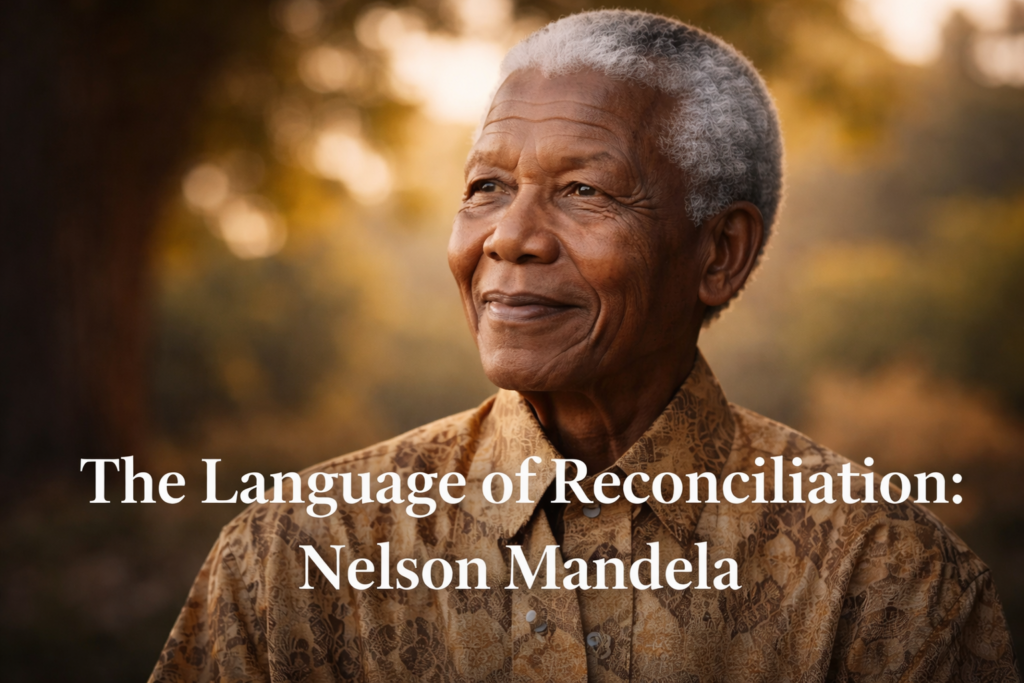
Upon his release from prison after a quarter of a century, Nelson Mandela was expected to deliver judgment to a world anxious to see the consequences of such a dramatic change in circumstances, to a world where history pointed to an expectation of judgment, to a world where there was every likelihood that judgment would be in the language of fire and brimstone, for there was every reason to suppose that the architecture of oppression would not crumble without a degree of violence, and there was enough pain in South African history to justify wrath; for Mandela was a man who had every reason to justify wrath, Nelson
Mandela knew this important detail of political fact that even the most effective leaders so frequently overlook: that words, at such junctures of transition, do not merely describe the world around them; they give it emotional direction. In this world, past divisions in South Africa were not merely political. Fear travelled more rapidly than law. Revenge was a plausible future. Thus, rhetoric was infrastructure. Tone was a choice that would unite or fracture the world.
What did distinguish Mandela’s speeches after apartheid was that they admitted to the existence of injustice, but did so in a plain way instead of with theatrics of outrage. However, what was most noteworthy was that he avoided people being reduced to terms such as “us” and “them.” This was not moral accommodation, but intellectual precision. Mandela understood that reconciliation was the only option other than retaliation, although forgiveness was not part of the equation.
Language was significant precisely because it represented actions. Mandela’s preference for dignity instead of humiliation empowered others in the same manner. His voice controlled the speed of collective feelings. It helped make patience conceivable in a moment when fury looked inescapable. It made it possible for institutions to take place.
What is not sufficiently credited is the discipline of the language. Reconciliation was not an easy or spontaneous process. It demanded the containment of urges that would have scored fulsome applause elsewhere. There is no spectacle or melodrama in the language of Mandela. He spoke as if he knew his words would travel much farther than the occasion warranted.
The strength of Mandela’s voice was not in its fluency, but in its refusal to simplify. Mandela did not promise healing that was free of costs. Mandela did not speak of unity in a way that forgot. He spoke of unity in a way that worked. That made reconciliation credible, not aspirational.
In an age in which moral conviction has been measured by decibel levels, Mandela’s legacy presents a different pace and timbre to conviction altogether. Some people have shaped history not by amplifying suffering, but by holding it in check. Reconciliation, said with conviction, has been known to be more powerful than revenge.

Articles

The Rise of Women Keynote Speakers Transforming Global Leadership
In today’s rapidly evolving world, leadership is no longer defined by traditional stereotypes. Organizations across industries are embracing diversity, innovation, and inclusive leadership, and one