

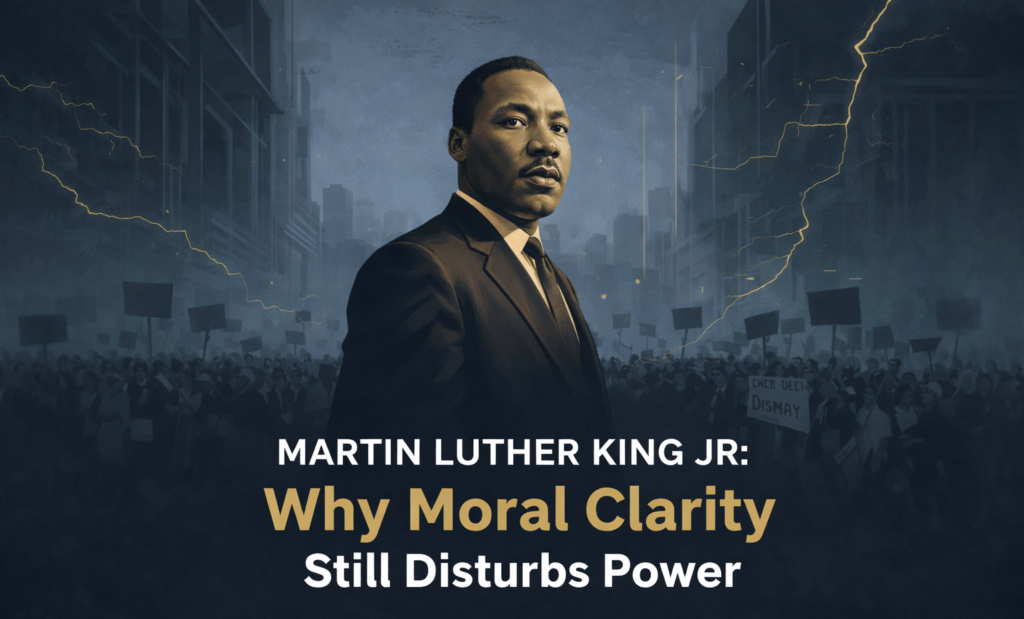
Martin Luther King Jr., however, is often remembered and referenced as an embodiment of harmony, yet it has been indicated that it was his edges, rather than his smoothness, that made him dangerous. Thus, Martin Luther King Jr., unlike the perception some have, did not shout for change, and he was not admired by everyone during his time. He was watched, criticized, and found troublesome because his voice was precise.
King spoke with moral clarity in a society obsessed with moral ambiguity. He shunned language that skirted or circumnavigated the reality of injustices. King’s speeches were not polite requests for inclusion. Rather, he insisted on being recognized for their contradiction. America, which prided itself on liberty but suffered the contradiction of segregation, couldn’t be comfortable with his words.
The reason King’s voice was effective was that it was rooted in ethical certitude rather than emotional up-and-down-ness. He was not a man of outrage alone. He had a cadence to his delivery, a discipline to his arguments, and a commitment to a shared value system that was hard to dismiss. He appealed to a language to which his opponents committed themselves, and reminded them of the disconnect.
Power finds such clarity threatening because it leaves little room for deflection. King did not allow injustice to be reframed as misunderstanding or impatience. He located it in law, habit, and economic structure. His voice turned moral failure into public fact.
This clarity, even in modern times, is still uncomfortable. King is often paraphrased, but his views on militarism and economic inequality are ignored. His voice is used, but the message is watered down. This is part of a general discomfort with speech that challenges people to be moral rather than to declare themselves so.
The strength of King’s message came because he refused to compromise truth for acceptance. He recognized that being articulate would mean he would be sacrificing his safety and popularity. His message was not meant to soothe, and it was certainly meant to awaken. Awakening meant he would be met with opposition.
The staying power of King’s voice is a reminder that clarity is not comforting in and of itself but rather disrupts comfort, disrupts equilibrium, disrupts choice. Clarities, particularly moral ones, require response; power resists being cornered.
To recall King with any degree of honesty is to recognize that his voice was not necessarily welcomed. It was tolerated, opposed, and assimilated. But the fact of assimilation does not negate it. It confirms it.

Articles

The Rise of Women Keynote Speakers Transforming Global Leadership
In today’s rapidly evolving world, leadership is no longer defined by traditional stereotypes. Organizations across industries are embracing diversity, innovation, and inclusive leadership, and one