

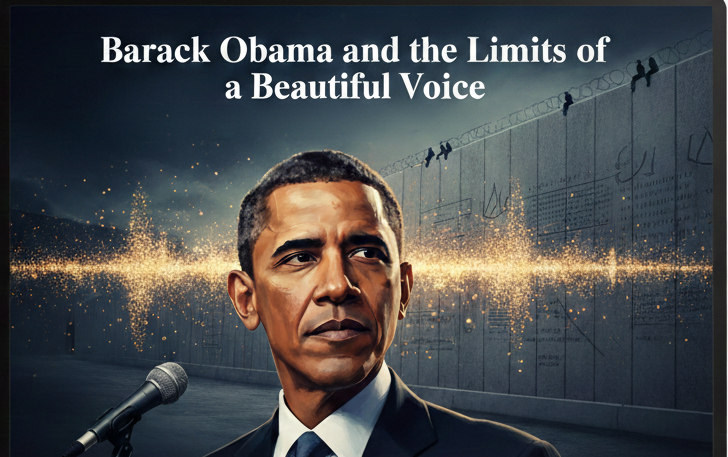
Barack Obama’s emergence was an instance—however brief—in which eloquence itself felt like renewal. Obama’s voice was the result of years in which political language had been dictated by discretion and control, and it renewed the idea that words could be noble again. His speeches were deliberate, contemplative, and baritonally exact. They were not cries of urgency but pleas for belief. In his voice, to be sure, to listen was to be spoken to, not to be handled.
This trait made his voice special, but it also put a burden on it. Eloquence is made to be delivered. People now put hope not just into the policies, but also into the voice. The rhythm became a symbol of change, and sometimes even replaced it. That is the beauty and curse of a pretty voice: it garners hopes even faster than the real world can catch up with them.
He was a man who deeply understood language. His speeches often acknowledged complexity and contradiction, resisting the temptation to simplify conflict into moral theater. Yet the very grace of his delivery softened edges that might have demanded confrontation. Beauty in speech can make difficult truths more palatable, but it can also dilute urgency. At moments that required rupture, it was often the voice offering reassurance.
This was not deceit. This was limitation. A voice, however fine, exists within structures it cannot bring down of its own accord. Obama’s presidency made this limit very clear. Rhetoric opened doors toward possibility, but the pace at which institutions shifted was another altogether. The gap between promise and reality became one of disappointment not because the voice was lying, but because it was powerful enough to invite belief.
Critics sometimes confuse this limitation with failure, but that misreads the role of speech. A voice can articulate vision, frame debate, and humanize leadership. It cannot substitute for political machinery or erase entrenched resistance. Where a voice is truly extraordinary in its power, the temptation arises to ask it to perform functions that ought to devolve to systems.
Obama’s legacy, then, is not only that of eloquence, but of exposure – exposure to the potential and the limitation of rhetoric, to the scope of the former and the confines of the latter. His voice revealed the power and the limits of rhetoric, the power to shift the imagination and the inability to transcend the imagination.
There is, as well, a restraint in acknowledging such limits. Speaking of such limits was not a common attribute of Obama’s address. His language was often laced with talk about process, compromise, and persistence. The letdown experienced was perhaps less because of what he said and more because of what we, as a society, want to believe about narrative resolution and reality’s refusal to comply. Beautiful voices make for good stories, reality does not.
In the final analysis, Obama’s voice is important not because it helped fix the political problems, but because it reminded people that leadership could sound thoughtful again. So, the limits of the voice do not make it less important. They clarify it. The voice can open doors for you, but it cannot walk through them for you.
This distinction, I said, is not a weakness of the speech, but its truth.

Articles

The Rise of Women Keynote Speakers Transforming Global Leadership
In today’s rapidly evolving world, leadership is no longer defined by traditional stereotypes. Organizations across industries are embracing diversity, innovation, and inclusive leadership, and one