
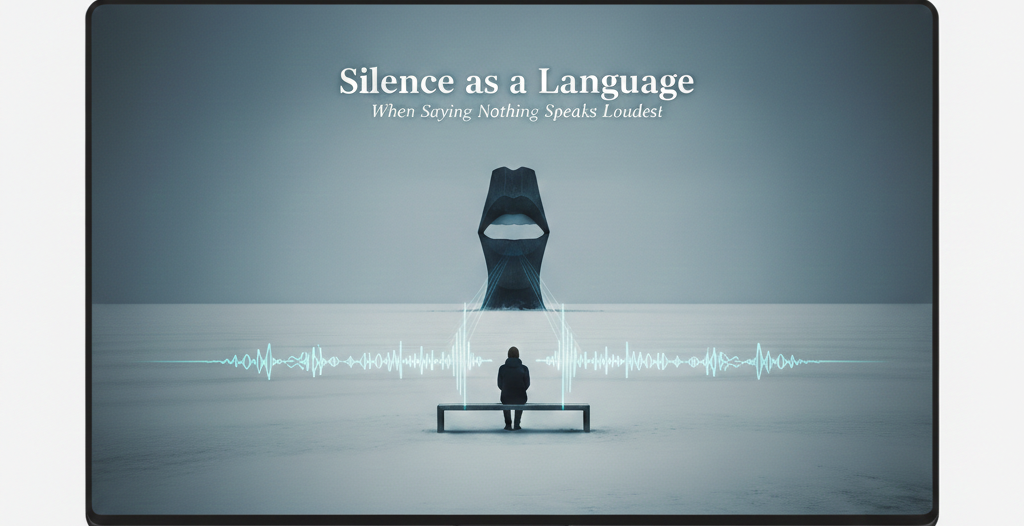
Silence frequently masquerades as absence, but silence in the world of man is presence of another sort. It takes up space without filling it, requiring attention without demanding it. In civilizations that valorize expression, silence implies weakness or subterfuge, yet history argues otherwise. Silence was used as a language, formal, calculated, and at times more potent than speech.
In moments of tension, words can become inflaming and silence conciliating. The art of diplomacy has always embraced the value of delayed responses and unuttered words as agents of negotiation. Sometimes, refusing to answer can highlight strength, doubt, or moral objection, depending on circumstances. The recipient has no choice but to grapple with the meaning, with no direction whatsoever.
This was traditionally understood in religious, philosophical, and cultural ways long before modern politics. Silence was seen to be associated with wisdom, not because wise individuals had nothing to say, but because they showed restraint in expressing wisdom. In the sense that speaking less meant having to imply that words were valuable, speaking was seen to be valuable.
Modern leadership only occasionally embodies such an understanding. For instance, if leaders choose not to offer immediate comments, then the mere act of holding their peace can, too, be communicative: it defies the need for immediate response and at the same time, implies that everything cannot be captured by the need for slogany.
Silence is also known to disrupt power structures. In communications where hierarchy is key, silence is used to deny validation. One denies their opponent any oxygen by choosing not to react or interact with them. Silence has been a tool for many movements. When silence is collectively levied, it’s impossible to ignore.
Nevertheless, silence is by itself not necessarily good. In its best form, silence can hide cowardice just as easily as it can convey restraint. In the realm of ethics, silence is a function of intention and outcome. Harm-shielding silence is very different from de-escalating silence. This involves the same silence, still devoid of sound.
What makes silence particularly potent is the impossibility of managing or controlling it. Words can be cited, modified, andmisrepresented. Silence, on the other hand, has no script to tamper with. It begs to be interpreted, and through thatinterpretation, it places the burden on the listener. Meaning is not given; it is derived.
Within a world that must at all costs produce, silence is increasingly a rare commodity. Hesitation is not rewarded, nor is start-and-stop behavior in the digital world. To stop is to become invisible. But the less prevalence it has now gives it greater power when it does occur. Silence fractures the beat, makes time slow down, causes contemplation.
“The use of silence, deliberately used, implies that not everything needs to be said. It is a good reminder that communication is not just about filling a space, but about creating one. Sometimes, the most powerful statement is the one that won’t be said.”

Shaping Minds Worldwide: 2026’s Most Powerful Global Speakers
Shaping Minds Worldwide: 2026’s Most Powerful Global Speakers Quick highlights