
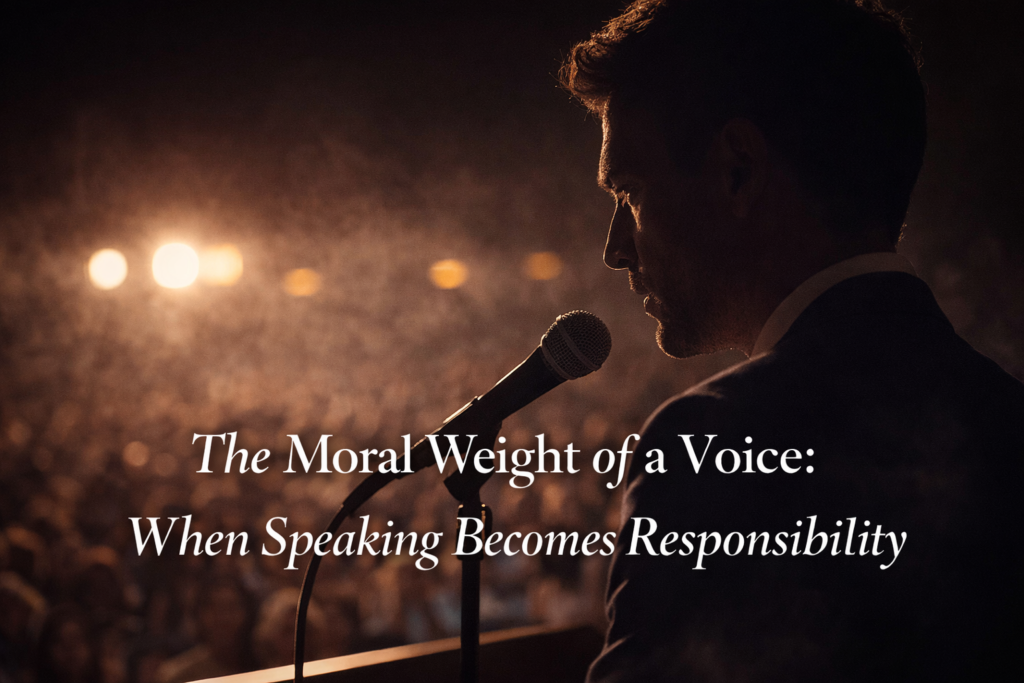
A voice is morally relevant the moment it transcends the self. As soon as words extend beyond the self, they cease to be personal expression and become public force. This coincidence is not often remarked but constitutes the ethical edge of speaking. Inadvertently, influence translates to consequence.
This has been the insight of the most powerful public speakers throughout history. They have known that to speak was to speak as a force that defined the path forward, not as individuals offering their opinions or perspectives. Nelson Mandela’s words, for instance, mattered because the struggle to overcome the legacy of apartheid was a struggle for national survival. To have spoken uninhibitedly would have been to invite bloodshed.
However, moral responsibility for speech does not require moral perfection. Rather, it calls for awareness. Indeed, all voices in public life speak in a way that, however partially, shapes our understanding of reality by drawing attention to some truth and distracting from others. A speech in which the speaker challenges this claim simply lacks accountability.
In the modern world, that obligation has grown exponentially. This is an era where influencers, commentators, writers, founders, creators, etc., are the equivalent of monarchs. Yet the ethics surrounding the way in which we express ourselves have not grown anywhere near that pace. Speed is rewarded, not thought. Certainty is rewarded, not honesty. The louder the megaphone, the more hesitant it is to stop and think.
This is not to say one should be silent. Silence is a moral choice, one with potentially equal weight to speaking. To be silent in the face of injustice is to allow existing power to speak unchallengeably. The issue is not with speaking, but, rather, with being aware of its limits.
Ethical speaking is the asking of difficult questions. Who are these words touching? What emotions am I evoking? And perhaps most uncomfortably, what actions do they make possible? There are no easy answers here, but there are no answers at all if the questions are unasked.
The gravity of a voice is perhaps most felt in times of uncertainty, when one is trying to find some sense of direction. And in those times, speakers do not simply describe the world; they shape it in some fashion or another, whether their words calm or escalate conflicts, whether they humanize or demote opponents to symbolic status.
History does not recall the voices that were not heeded, but it recalls the results of the ones that were. Being responsible is not about controlling the way people will interpret what is said, but about not acting as if the words one says do not matter. To say anything in public is to recognize that once one’s language is out in the open, one no longer controls it.

Shaping Minds Worldwide: 2026’s Most Powerful Global Speakers
Shaping Minds Worldwide: 2026’s Most Powerful Global Speakers Quick highlights