
A keynote speaker and author helping people shift from constant activity to meaningful focus!
The modern workplace demands a pressure that rarely gets questioned, where people measure their worth by how full their day looks, how fast they respond, and how much they juggle at once, even when that pace leaves little room for clear thinking or meaningful progress. Many professionals move through long to-do lists, yet end the day with a sense that little of real value has been created.
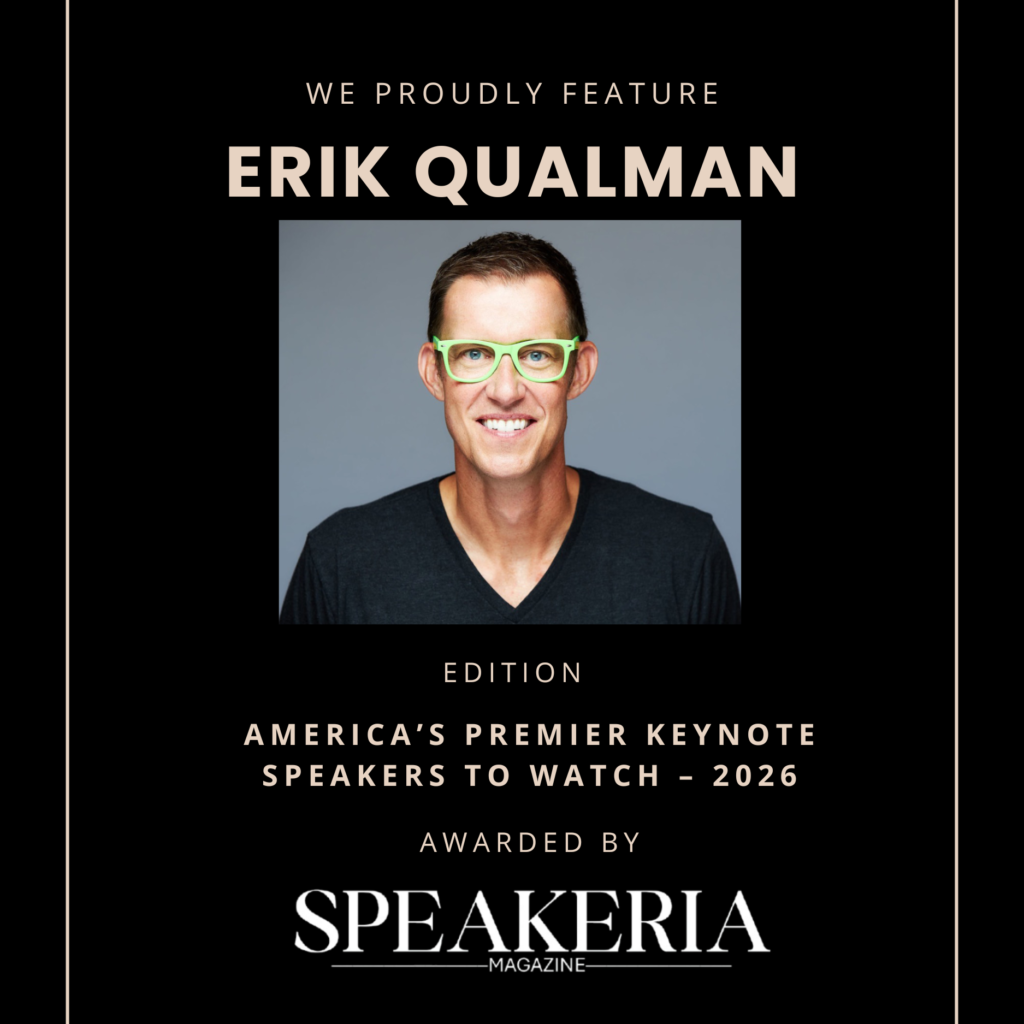
Erik Qualman steps into this space with a perspective that feels both simple and difficult to practise, urging people to focus on what truly matters instead of getting lost in constant motion. His work speaks to a growing need for clarity in a world filled with distractions, where technology often demands attention rather than supports intention.
His idea of being “Flawsome” demonstrates a mindset that values learning through action, where mistakes serve as a path to growth rather than something to avoid. He sees failure as a teacher, encouraging people to move faster, learn quicker, and improve with each step. This approach resonates in industries characterized by rapid change, where hesitation often incurs greater costs than imperfect action.
As an author, his influence spans years, from Socialnomics to his recent book, The Focus Project. Readers often return with stories of how his ideas helped them step away from unnecessary noise and direct their energy towards what truly counts. His message centers on doing less with greater intent, a principle that challenges the habit of equating busyness with success.
His interest in artificial intelligence and co-intelligence follows the same thread, where technology serves as a tool to improve human life rather than overwhelm it. As an AI Keynote Speaker, he speaks about innovation in a grounded way, keeping the focus on people and their everyday decisions.
Qualman’s work holds a steady reminder that progress comes from clarity and that a life filled with purpose often begins by choosing what to leave out.
When Greatness Feels Human
Having delivered keynote speeches in 60 countries, Qualman has many “wow” moments. For Qualman, one such moment came during an event that brought together influence, history, and something far more unexpected.
One keynote event that still gives him chills happened while he was an AI Keynote Speaker at a Fortune 50 event in South Africa. They had a private dinner set up inside Kruger National Park, and he found himself sitting between Tony Hawk and Steve Wozniak.
As they were eating, giraffes were walking by in the distance, and lions weren’t far off; it felt surreal. But what struck him most wasn’t the setting or even who he was sitting next to; it was how both Hawk and Wozniak showed up. Despite everything they’ve accomplished, they were incredibly curious, humble, and fully present.
Later that week, Nelson Mandela spoke at the event to kick off Soccer’s World Cup. Being in that environment, where greatness, history, and humility all intersected, was something he will never forget, and it’s why he loves being a motivational speaker
And a few years later, he had another moment like that. Qualman was one of the keynote speakers at SXSW. He was backstage with then-President Barack Obama, and instead of talking about policy or world issues, they ended up talking about college basketball. Qualman played for Hall of Fame coach Tom Izzo, so they connected on that level.
Those moments remind him of something he has seen all over the world: the people who achieve the most are often the most grounded, curious, and human. That is what really sticks with you, and that is what still gives him chills. And, now that Qualman is an AI Keynote Speaker and professor (Northwestern University), he never loses sight of the human touch.
From Pages to People
Writing forces clarity. Speaking demands connection. The shift between the two reshaped how Qualman approaches a room full of people.
Writing his first book fundamentally changed how he approaches motivational speaking. It reinforced that while it’s important to know your content, it’s even more important to know your audience.
A book is one-way—you’re sharing ideas. But a keynote speech is a shared experience. He is not speaking to people; he is welcoming them in. That shift changed everything for him. Now, he designs every talk as an experience. He asks the audience questions, has them engage in exercises, interact with each other, and even move, physically and emotionally. It is about creating moments, not just delivering messages.
One of his favorite parts of being a keynote speaker on focus is seeing the entire audience put on their signature green focus glasses. In that moment, they are not just listening, they are part of something. They are engaged, energized, and connected. That is the biggest lesson writing taught him: content matters, but connection is what creates impact.
Keeping Every Audience New
Qualman is a keynote speaker who addresses institutions as varied as NASA and global corporations. As such, repetition could easily creep in. However, for Qualman, the opposite is true.
It’s actually what keeps keynote speaking so exciting for him; no two audiences are the same. Whether it is the Mayo Clinic, Google, NASA, or Starbucks, the core ideas around leadership, innovation, and AI stay consistent, but the experience is completely different.
As a motivational speaker, Qualman spends a lot of time upfront understanding the audience, what they care about, what challenges they are facing, and what success looks like for them. Because again, it is not about speaking at them, it is about welcoming them into something that feels built just for them.
That is where it stays fresh. He is constantly learning from each group, adapting stories, asking different questions, and creating new ways for them to engage with each other. The interaction changes, the energy changes, and the takeaways evolve.
At the end of the day, the magic happens when the audience sees themselves in the message. When that happens, it is not just another keynote speech; it becomes their experience.
Building Something from Nothing
Creative work often begins in silence. A blank page, an unformed idea, and the pressure to make it matter. That tension is what pulled Qualman toward building something of his own.
What drew him to creating Equalman Studios was a simple idea: “I love creating something out of nothing.” Whether it is script writing, music, design, or animation, it all starts as a blank page and comes out of his head. There is something incredibly energizing about bringing an idea to life and seeing it resonate with others.
Working with iconic brands like Disney and Chase has taken that to another level. He still pinches himself sometimes. You are not just creating for yourself; you are helping shape stories that reach millions of people.
Animation, in particular, has transformed his storytelling. It forces him to simplify complex ideas into something visual, emotional, and instantly understandable. He must get to the essence, what really matters, and express it in a way that connects in seconds.
That discipline has carried over into everything he does, especially on stage. It has made his storytelling tighter, more visual, and more impactful. At the end of the day, whether Qualman is video storytelling or a keynote speaking, it is all about turning ideas into experiences that people can feel and remember.
The Shift from Speaking to Experience
The future of keynote speaking is already visible if you look closely at how audiences respond today. Attention is shorter, expectations are sharper, and passive listening no longer works.
Projecting forward to 2027, the biggest shift he sees is not in what keynote speakers say, but in how they connect.
Audiences are no longer looking for a speech; they are looking for an experience. They expect something that feels personalized, interactive, and built for them, not something generic. In fact, event trends already show that audiences want content that feels tailored and engaging, not one-size-fits-all.
At the same time, AI is playing a bigger role behind the scenes, helping speakers better understand their audience, personalize content, and even adapt in real time. But one thing stands out clearly: as technology increases, the demand for human connection increases even more.
So, the future is not more slides or more information, it is more interaction. It is asking the audience questions, getting them involved, having them engage with each other, and creating moments they feel, not just hear.
That is where keynote speaking is going. Less presentation, more participation. Because in a world where content is everywhere, connection is what stands out.
The Part No One Sees
From the outside, a career like Qualman’s looks like momentum without friction. Reality carries its own weight, especially when personal identity and public presence start overlapping.
It has been incredibly fun, but also incredibly challenging. He comes from the Tom Izzo school of thought: “It’s not about me, it’s about we.”
The hardest part is the self-promotion that comes with building a personal brand. That has never been the goal. The way he pushes through is by focusing on the mission because it is bigger than any one person. Their mission is to entertain, educate, and empower people to reach their best leadership and life in this digital age.
He often thinks about Walt Disney. He started with his personal brand but ultimately built something that lives far beyond him and impacts people every day. That is the aspiration. There are days when he does not have the energy to be “on” to perform, shake hands, sign books, but those are great challenges to have. What keeps him going is the mission and the people they are fortunate to serve.
At the end of the day, it is the audience that fuels everything, their smiles, tears, laughter, and kind words. That is what keeps him showing up.
Where Motivation Meets Usefulness
In large organizations, motivation alone rarely survives past Monday morning. What lasts are tools people can actually use when they return to their desks. That balance shapes how Qualman builds every motivational keynote.
For organizations like Raytheon, Mondelez International, and Takeda Pharmaceutical Company, the key is blending inspiration with application. Motivation gets people excited, but without practical takeaways, it fades quickly. So he designs every keynote to do both. He wants people to feel something in the moment, but also leave with tools they can use the very next day.
That starts with understanding the audience. What are their pressures? What does success look like for them? Then he tailors the content so the stories, examples, and frameworks connect directly to their world.
From there, it becomes an experience. He asks questions, involves the audience, has them engage with each other, and gives them simple, actionable frameworks, whether that is focusing on BIG versus busy, embracing “Flawsome,” or leveraging AI as a co-intelligence partner.
The goal is simple: when they walk out, they are not just motivated, they are equipped. Because the best keynotes do not just inspire change…they make it easier to act on it.
When a “Prank” Turned Real
Some projects begin with a pitch. Others begin with disbelief. This one started with a date that made it easy to dismiss.
The wildest project started with what he thought was a prank. Disney reached out on April 1st, and he assumed it was an April Fools’ joke.
Thankfully, it was not. That first project turned into multiple collaborations, and it was one of those “pinch me” moments, realizing that the same creative process they use every day could resonate at the highest level.
It reinforced something he believes deeply: when you create something authentic from nothing, you never know how far it can go.
Or, as Walt Disney said himself, “If you can dream it, you can do it.”
Before the Lights Go On
What happens before stepping on stage rarely gets attention. Yet it often determines whether a talk lands or disappears the moment it ends.
His pre-stage ritual is a mix of getting his body ready and getting his mindset aligned with the audience.
Physically, he will stretch and do some breathing exercises to center himself and bring the right energy. But the most important part happens backstage. He tries to connect with people from the audience or executives and asks them two simple questions: What are you most excited about right now? and What could prevent you from achieving it?
That conversation becomes the anchor. It puts him directly into the audience’s mindset, what is top of mind for them, their dreams, their fears. Every audience is different, and he wants to meet them exactly where they are, not where he thinks they are.
So by the time he steps on stage, he is not delivering a speech; he is stepping into a shared moment. He is in their headspace, their energy, their reality. And that is what allows him to truly connect and fire up a crowd.
When the Audience Becomes the Editor
Reaching millions as an AI Keynote Speaker does something subtle. Patterns begin to emerge. What lands, what fades, and what actually changes behavior becomes hard to ignore. Qualman treats that feedback as more than applause; it becomes direction.
The biggest way feedback has shaped his work is that it has turned everything into a two-way conversation. When he has had the opportunity to reach over 60 million people, he starts to see patterns, what resonates, what sticks, and more importantly, what changes behavior. He pays close attention to that. The stories people share, the questions they ask, even the parts they lean into or push back on, all become data.
That feedback has made his content simpler, more actionable, and more human. It is why concepts like Flawsome and focusing on BIG versus busy have evolved; they have been pressure-tested in the real world.
It has also reinforced something important: people do not just want information, they want transformation. So every book and every keynote has shifted from just sharing ideas to creating experiences that people can apply immediately.
In many ways, the audience has co-created the content over time. They have helped refine it, sharpen it, and make it more impactful.
What Truly Moves People
Across industries, roles, and hierarchies, motivation is often misunderstood as energy or push. Qualman’s experience points somewhere quieter and more consistent.
One universal lesson he has learned as a motivational speaker, whether it is working with NASA or everyday leaders, is that motivation is not about pushing people; it is about connecting with them.
No matter the industry, people want to feel seen, heard, and part of something bigger than themselves. The specifics of their jobs may differ, but their drivers are the same: purpose, progress, and connection.
That is why it is so important to understand your audience. What are they excited about? What are they worried about? When you tap into that, when you meet people where they are, you can turn a message into something meaningful.
He has also found that motivation sticks when it is paired with action. It is not just about inspiring someone in the moment; it is about giving them something simple and practical they can do next.
At the end of the day, across every industry, motivation comes down to this: people do not remember what you said, they remember how you made them feel and what you helped them do.
A Stage Bigger Than the Room
After speaking across industries and continents, the next step is not always about scale. Sometimes, it is about where impact could travel next.
If given the choice, he would be honored to speak at the United Nations General Assembly.
Not for the stage, but for the impact. His hope would be that a message around empathy, innovation, and co-intelligence could help leaders find common ground. Even a small shift in understanding at that level could ripple outward and maybe move the world one step closer to peace.