
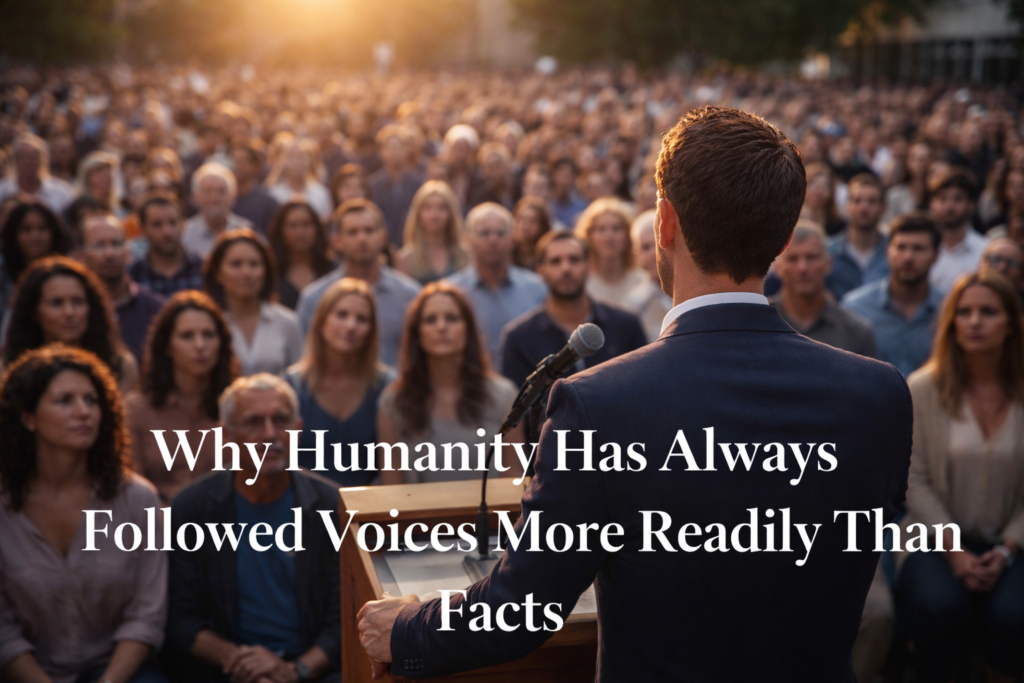
Human history has largely been portrayed as a movement of knowledge through the ages, but in truth, it has been a movement of belief. There has been access to facts throughout the ages, but facts have rarely been the governing powers. Instead, the movement of societies, even before the first book was ever written, was due to the voices that brought tribes together, conflicts, wars, and even gods. The intention that humans will follow voices as opposed to facts was not a defect of modern society but was a fundamental psychological attribute.
Ancient civilizations knew this at an instinctive level. In Greece, rhetoric was not the supporting pillar of politics but the very foundation of it. In fact, Aristotle defined persuasion in terms of credibility and emotiveness in addition to rationalism, because he knew the truth would not be received like rationalism suggested. “The truth would be received and processed not as rationalism would hope, but as social beings responsive to fear, hope, identity, and trust.” This knows no change. Modern neuroscience tells us how emotions come first, and only then the rational processing of them.
This is why facts alone so often fail to persuade: an accurate statistic needs a human voice with which to sail; a fact without a story behind it will always remain inanimate. In times of crisis, people don’t look for data; they look for reassurance, clarity, and direction. When Franklin D. Roosevelt spoke to a nation crippled by economic collapse, his words did not straighten out the economy, but his voice steadied panic. Confidence coursed into the public bloodstream well before policy ever could.
We see this pattern repeated across cultures and centuries: religious movements succeeded not because doctrines were airtight, but because prophets spoke with conviction. Revolutions happened not when conditions were objectively worst, but when voices emerged who could name collective frustration and turn it into purpose. To this day, our digital platforms reward voices that sound certain and emotionally legible over those that are merely correct.
The reality, rather than being viewed as problematic, which it often is, is really better conceptualized as a situation rather than a weakness to be eliminated, and it becomes more helpful to think of humans as storytelling creatures, making sense of chaos and complexity by using narratives and tone. “Voice” puts facts into bodies and rhythms and puts them into motion, and without voice, the truth doesn’t travel well.
The risk is not in the voices, but in submitting decision-making to them. Trust, in lieu of critical examination, often sparks manipulation. There are such numbers of examples from the past to illustrate voices that inspired belief without genuine morality. Would the answer be to dismiss voice entirely, however, because in that world, we are fractured and skeptical, incapable of joining together to take action?
The question, therefore, becomes not one of voice or facts, but of voices that honor facts and facts that are articulated with responsibility. Humankind has always followed voices because voices have a sense of humanity. The question that faces every generation is which voices it should follow.

Shaping Minds Worldwide: 2026’s Most Powerful Global Speakers
Shaping Minds Worldwide: 2026’s Most Powerful Global Speakers Quick highlights